“Many major works of art from history are commissions. From Titian right up to Warhol. Andy Warhol’s final ‘Last Supper’ series was commissioned by gallerist Alexandre Lolas.
The reason Goya in the Prado came about because it was commissioned by someone with a passion for Art.
I think commissioned paintings not only reflect the wishes of the commissioner but also what is happening in the artists life at the time so its always a bit of a collaboration were ideas can be shared.
As the artist, It might be ideas, colours or techniques that I’m looking at but I will always try and put new things into my latest work. I often visit galleries and view past works I am inspired by. I always research thoroughly.
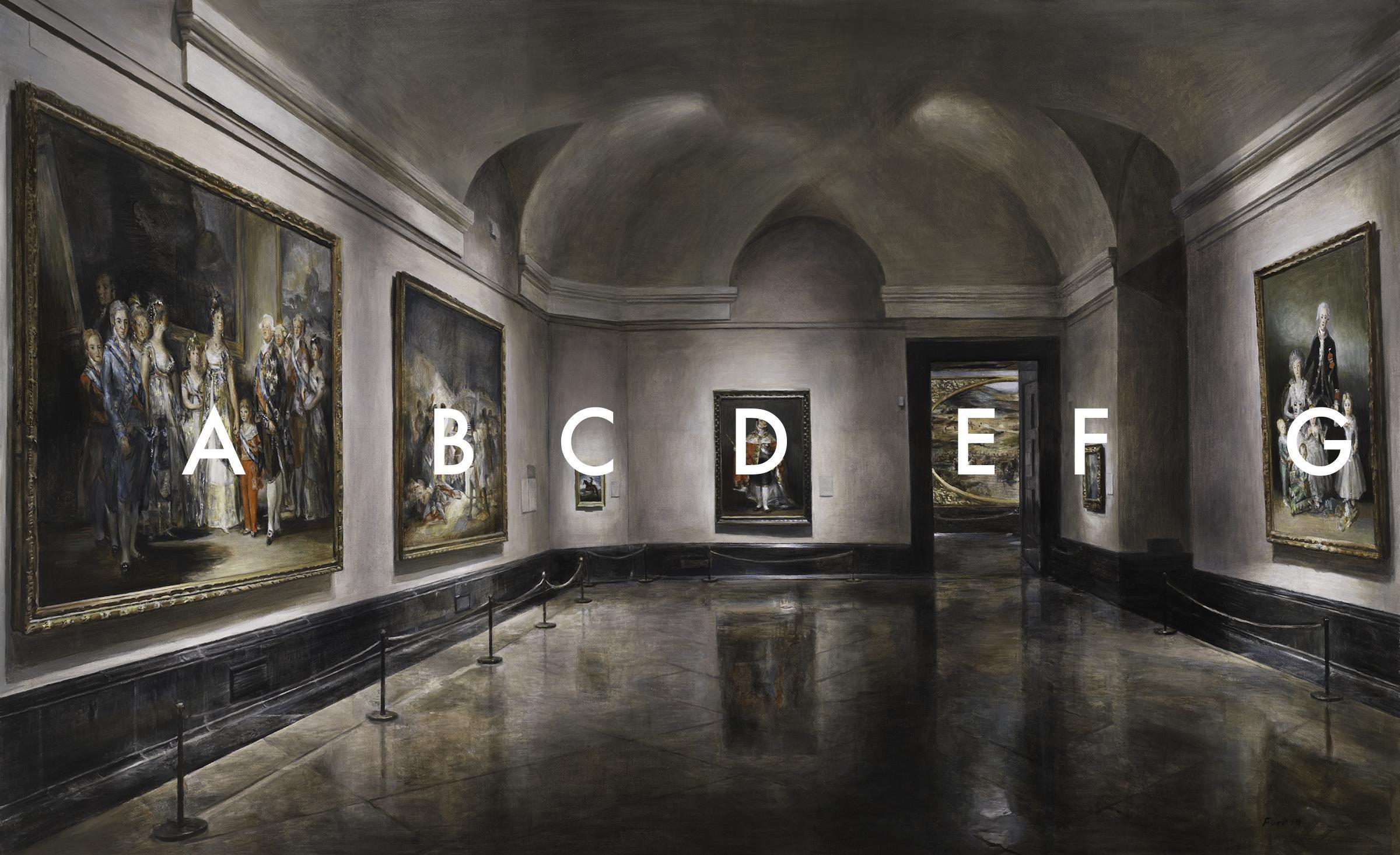
‘Goya in the Prado’ was a commission. A New York financier suggested that I create a large painting of a gallery. He is particularly fond of Goya and Goya’s royal family portraits and wanted to include them in one space with other Goya’s viewed with one point perspective in the middle of the gallery. The gallery in question was the Prado in Madrid.
I always think spending time in a gallery is like having a conversation with artists from the past. Painting can be an illusion that tells the truth. I thought this painting could be a celebration of art.
In the summer of 2020 I visited the Prado. I hired the gallery for an hour.
In my painting I have included Goya paintings that were in different rooms and put them all in one room – Room 64. When I was at the Prado, I went into different gallery rooms with my camera, to get the reference I needed. In one of these rooms, I discovered an unfinished canvas by Goya covered in a vivid orange. This is what gives Goya’s portraits their glow.
The subject of ‘Goya in the Prado’ is a gallery room in the Prado in Madrid and the paintings of Goya that hang within it. The scene is without any people in it other than those featured in the paintings. Paintings by an artist who was commissioned by the Spanish royal family to create portraits of them. Like Goya I was also commissioned for a royal portrait. Goya even includes himself painting the family in one of the portraits. So, I featured this in the top left corner of my painting.
I wanted the viewer to feel a little like a mouse who has wandered into this grand space when there is no one present.
Grand galleries like this to me are like portals to a kind of block time where past present and future converge. Only the exceptional people make it to its walls. Like the best songs, paintings are the result of crystallised ‘creative flow’ I think. Thats why people are drawn to them over and over again because you experience what the artist experienced making it.
‘Goya in the Prado’ is a big painting for a reason. When you look at it, you are in it. It took me several weeks to complete it in my studio on Richmond hill. wanted to recreate my own unique experience visiting the gallery alone.
In the left central area is Goya’s masterpiece the Third of May 1808. Manet painted his own updated version of this scene with the execution of Maximillian.
Copying or reappropriating masters works is nothing new. This is what my ‘Homage’ series of paintings are about.
Getting the drama of the lighting in the gallery was important. If you look closely though you won’t see the actual lights in my painting as I decided to take them out and just leave the light pools on the walls instead.
There are lots of colours in the painting as well as likenesses. I concentrated on the placement of the red. It’s like the bloodstream in any work of art.
In the foreground on the left – In the painting of ‘La familia de Carlos IV’ behind the family are the kings paintings. So my painting becomes a painting of paintings of paintings. It’s very meta and I like that about it.
Importantly, like Velázquez in Las Meninas, Goya made himself the artist as important as the royal family as he was painting by painting himself in the scene looking out from behind his easel. This way he gives the recorder of the scene – equal footing. Without the recording we have no memory of events.
In the right lower corner in the ‘Los Duques de Osuna y Sus Hijos’ if you look between the children in the background there is a skull in the shadows.
Goya escaped the oppressive rule of Ferdinand VII, who appears in the central portrait, and spent the last four years of his life in Bordeaux and the small painting central right is the Milkmaid of Bordeaux – purportedly the artists daughter.
Every work of Art is a reach for immortality. The paintings that Goya left behind are now how he exists in the physical world. This is why I called it ‘Goya in the Prado’ instead of ‘Goyas in the Prado.’
Commissioner’s thoughts
“There are several aspects to why I commissioned this work and why Christian Furr was the artist I hoped would agree to execute it.
I have a great love of old masters and 19th century art. Goya’s works and the Prado museum are perhaps my favorites. I had seen this specific gallery on my first visit to the Prado and it made quite an impression.
Also, over the course of the preceding months leading to the commission I had seen images of, and many works of, professional photos of museum and gallery spaces. They have become somewhat fashionable it seems. Some of them were photos of museum galleries of old master paintings. I strongly considered buying a particular one that was large scale.
There were two reasons I did not purchase it. One, painting is what I most enjoy viewing and the piece I considered was instead a “photo” of the paintings and gallery. Secondly, I most loved another gallery, that being the Goya gallery at the Prado.
It was around this time I serendipitously saw an image online of the Goya gallery and examined it closely. I remembered the gallery well and it occurred to me, having just considered acquiring the photograph, that being able to view this Goya gallery from the Prado on a daily basis in my living room would be a dream.
I wanted it to scale and done in a hyper realistic fashion. In addition, my wish list included substituting, to scale, two of Goya’s other master works, also at the Prado, for two that were in the actual gallery.
I had no idea if this was even feasible. I knew if it were, it would require a particular type of talented artist to execute. I was surprised upon reflection I had not seen this type of work before if it were in fact feasible.
My friend and art advisor, Issiaka Toure, had suggested for some time I consider commissioning a work from Christian Furr. I had examined some of his work and was impressed not only with the commission for the Queen (in his 20s no less), but with the qualities of his portraits. Many had an old master feel to me yet in a fresh manner.
With my ideal work in mind I reviewed his portfolio again which I had not seen for a year or so. I was again very impressed with his portfolio.
I came across two specific works, the “Thomas van Straubenzee and Lady Melissa Percy” portrait and the “Lise Grendene” portrait.
In the first, some classic paintings were prominent in the portrait just as I envisioned for the commission. In the “Lise Grendene” work, I literally viewed the work three times to make certain it was not a photo it was so realistic, and again, a work of art was featured in the piece. Paintings of paintings.
I knew at this point if the work could be done Christian Furr was the artist. Issiaka made a formal introduction and Christian and I discussed the idea. I didn’t know until then how much he too loved Goya’s works.
He seemed to have great passion for the project and agreed to the commission. It was an incredible and time consuming effort on his part to execute the work. The result is breathtaking. “
PAINTINGS THAT FEATURE IN THE WORK (listed with their usual locations in the Prado)
A: Francisco de Goya, The family of Charles IV (La familia de Carlos IV) (Room 32)
B: Francisco de Goya, The Third of May 1808 (El tres de mayo de 1808 en Madrid) (Room 64)
C: Francisco de Goya, A Picador (Un Garrochista) 1795 (Room 64)
D: Francisco de Goya, Portrait of Ferdinand VII of Spain in his robes of state (1815) (Room 64)
_-_Prado.jpg)
F: Francisco de Goya, The Milkmaid of Bordeaux (La lechera de Burdeos) 1827 (Room 64)
G: Francisco de Goya, The Duke and Duchess of Osuna and their Children 1788 (Los duques de Osuna y sus hijos) (Room 35)
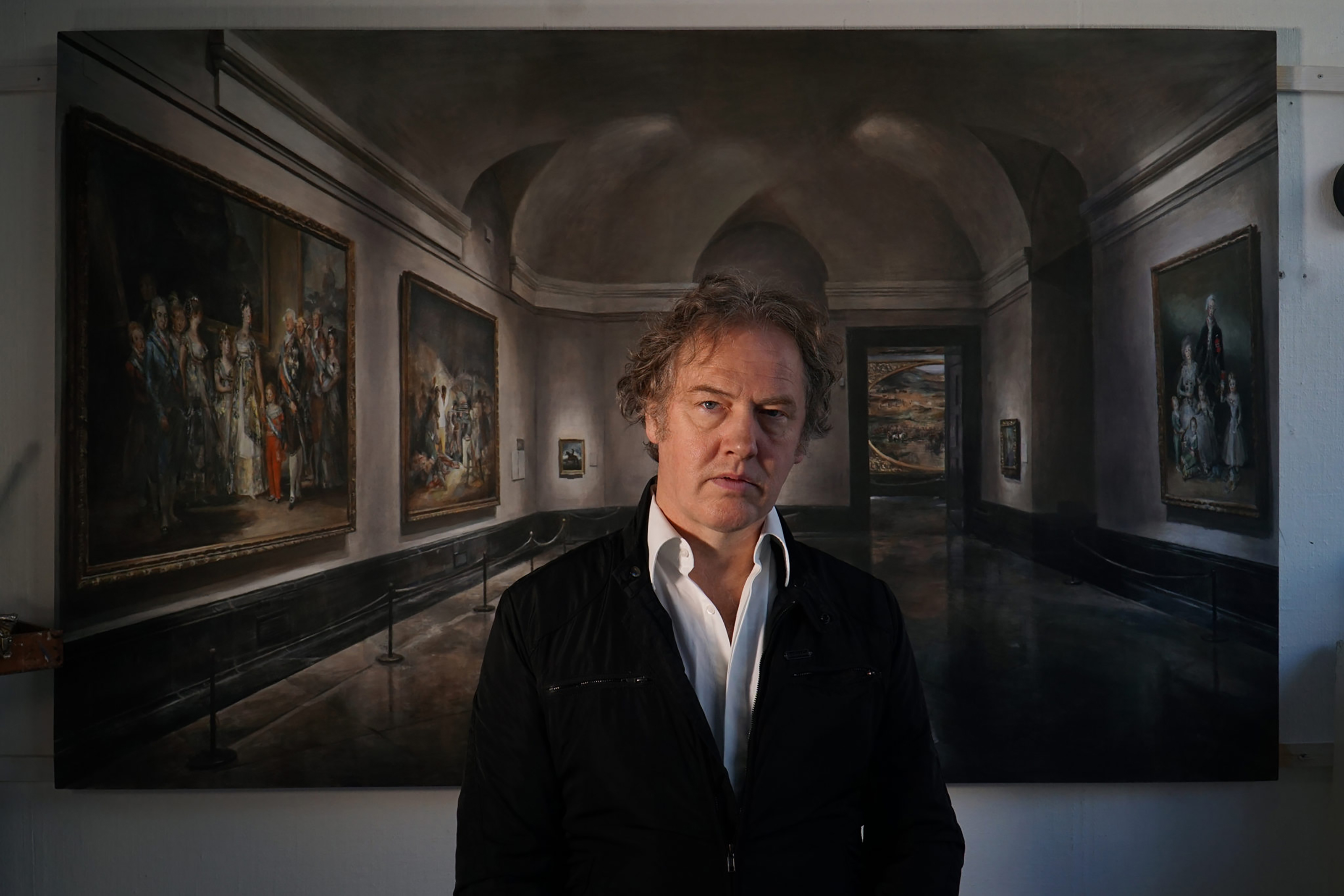
Furr photographed by Gered Mankowitz 2019

Furr gathering reference at the Prado, Madrid 2019
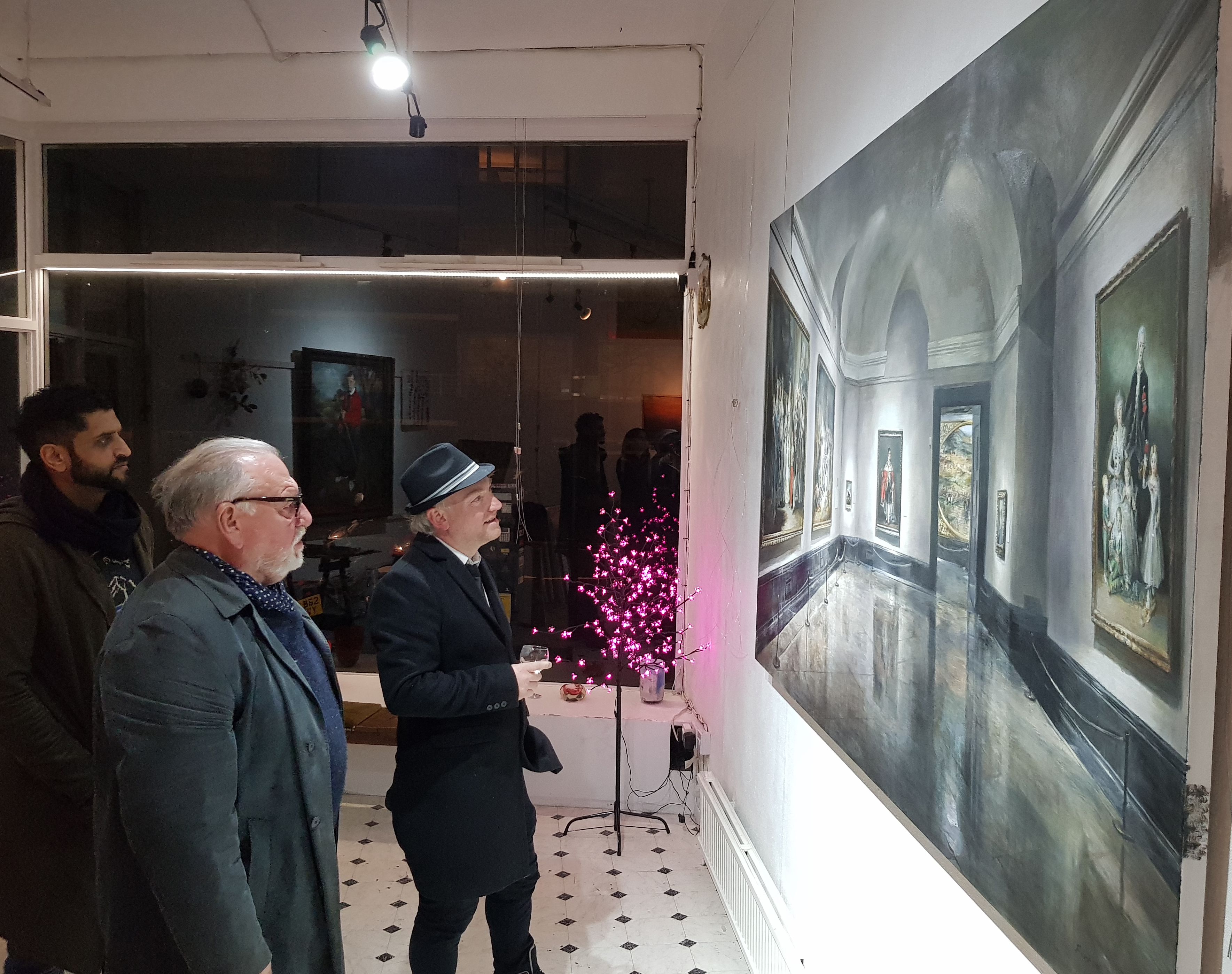
Actor Ken Cranham viewing the work at Furr's studio Richmond Hill 2019
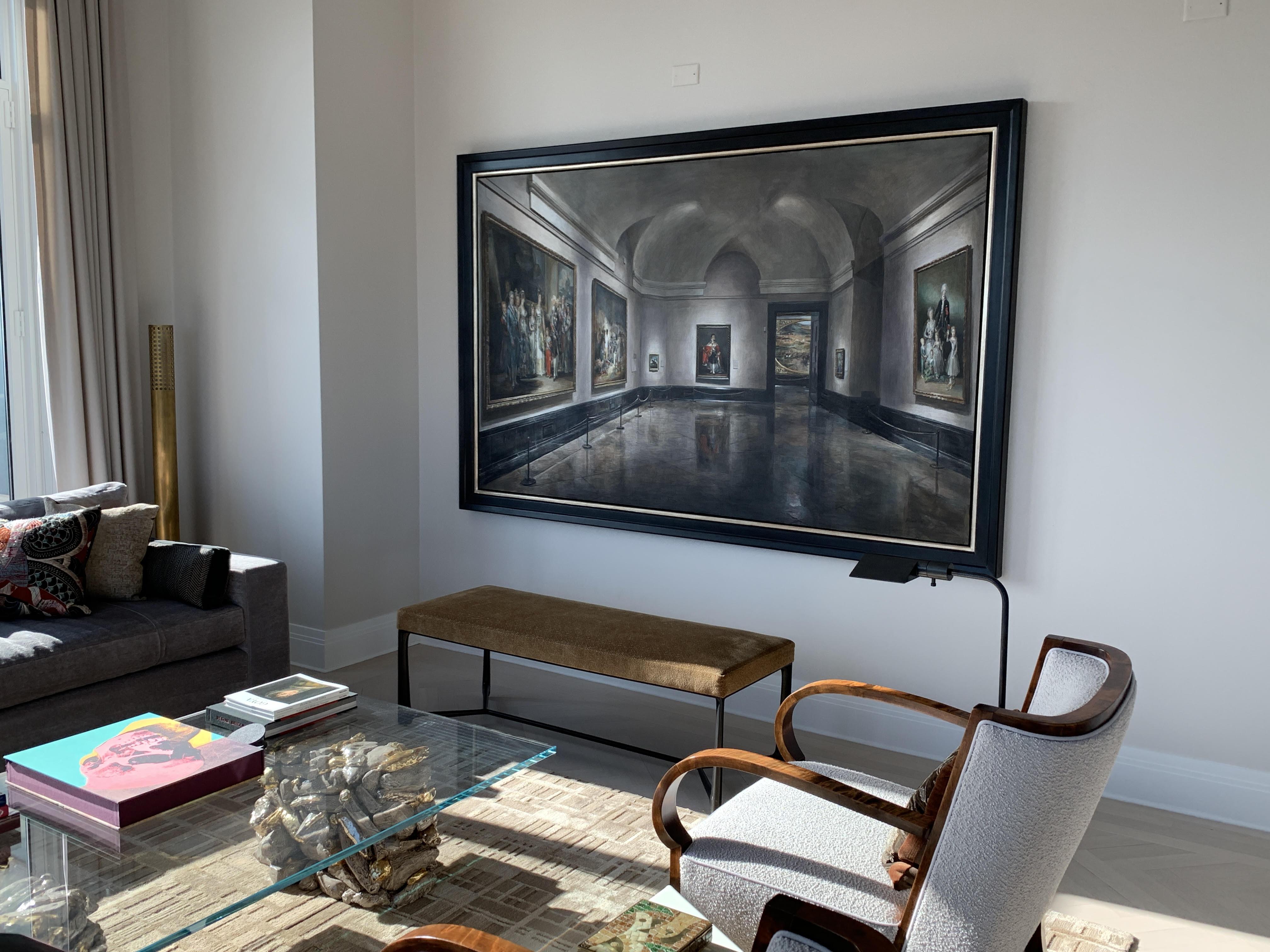
The painting in situ, New York 2019

Thomas van Straubenzee and Lady Melissa Percy by Christian Furr 2014

Lise Grendene by Christian Furr 2016